You've probably noticed it if you've ever traveled abroad or followed a recipe from another country: the US measures liquids differently from almost everyone else on the planet. While the rest of the world reaches for liters, Americans reach for gallons, quarts, and fluid ounces.
It's not stubbornness — at least not entirely. There's a surprisingly rich and genuinely interesting story behind why the US uses gallons instead of liters, involving revolutions, political battles, failed laws, and the sheer inertia of a nation that built itself around one system of measurement before another came along.
Let's unpack it properly.
What Is a Gallon vs a Liter?
Before diving into the history, it's worth getting the basics straight — because the gallon vs liter difference is bigger than most people realise.
A liter is the standard unit of liquid volume in the metric system. It equals 1,000 millilitres and was designed to be a clean, logical unit based on the physical properties of water. Nearly every country on Earth uses liters as their everyday liquid measurement.
A US gallon is a unit from the US customary system — the American adaptation of old British imperial measurements. One US gallon equals 128 fluid ounces, 4 quarts, or 3.785 liters. It's a larger unit, less mathematically elegant, but deeply embedded in American infrastructure and daily life.
The relationship between the two is straightforward to calculate — our free oz to liter converter handles it instantly — but the cultural and historical reasons behind why they coexist are far more interesting.
Why the US Uses Gallons Instead of Liters
The short answer: timing. The United States formalised its measurement system before the metric system was invented. By the time metric came along as a cleaner alternative, America had already built its economy, infrastructure, and everyday habits around customary units. Switching would have meant changing everything at enormous cost — and the will to do so never materialised.
But the longer answer is much more interesting, and understanding it requires a quick trip back through history.
The Historical Background
Colonial Roots
When European settlers arrived in North America, they brought British measurement units with them — pounds, yards, gallons, and fluid ounces. These weren't chosen for scientific elegance; they evolved organically over centuries from Roman, Norman, and Anglo-Saxon traditions. A gallon was originally defined as the volume of 8 pounds of wheat. Not exactly a recipe for precision.
By the time of American independence in 1776, these units were so thoroughly embedded in commerce, agriculture, and everyday trade that they were simply the water everyone swam in. Nobody questioned them — they were just how things worked.
The Metric System Arrives (Just Too Late for the US)
The metric system was developed in France during the 1790s, emerging from the revolutionary spirit of the era — a deliberate attempt to replace the messy tangle of regional measurements with something logical, universal, and base-10. The liter was defined as the volume of one kilogram of water. Clean, reproducible, and scientific.
The timing was unfortunate for America. The young United States was still finding its feet as a nation. The founding fathers were actually curious about the metric system — Thomas Jefferson explored the idea of a decimal-based measurement system — but the country was too busy establishing itself to implement a wholesale measurement overhaul. The moment passed.
Britain Chose Different — And So Did America
In 1824, Britain standardised its own imperial system, creating the imperial gallon (4.546 liters — larger than the American gallon). Rather than adopting the metric system that France was pushing, Britain doubled down on imperial. Since the US had already diverged from the British system slightly (the US kept the older wine gallon of 3.785 liters), this created three incompatible systems: US customary, British imperial, and metric.
The rest of the 19th century saw most of the world gradually adopt metric. The US watched but didn't follow.
Why the US Didn't Fully Adopt the Metric System
This is where it gets genuinely fascinating. The US didn't avoid metric because of ignorance — it came remarkably close to switching, multiple times.
The Metric Conversion Act of 1975
By the early 1970s, America was feeling the pressure. Trading with metric countries was becoming increasingly awkward, and the industrial and scientific communities were pushing hard for change. In 1975, Congress passed the Metric Conversion Act, establishing a board to coordinate a national transition to metric.
There was just one critical problem: the Act made metrication voluntary. There was no legal requirement for industries or the public to switch. Without a mandate, the transition stalled almost immediately. Businesses saw no competitive reason to retool their factories. Consumers pushed back against unfamiliar units. And politicians, reading the public mood, quietly let the initiative fade.
The Omnibus Trade Act of 1988
Congress tried again in 1988, requiring federal agencies to use metric in their procurement and business dealings. The scientific and military communities largely complied. But consumer products, road signs, fuel sales, and everyday life remained firmly in gallons, miles, and pounds.
Why the Public Resisted
Change at this scale is never just a technical problem — it's a cultural and economic one. Consider what switching to metric would actually require:
- Replacing every road sign in the country (miles → kilometres)
- Retooling every fuel pump (gallons → liters)
- Reprinting every food label, recipe book, and packaging standard
- Retraining an entire workforce and education system
- Replacing tools, machinery, and manufacturing equipment built to customary specifications
The estimated cost of full metrication runs into the hundreds of billions of dollars. And the perceived benefit — easier international trade — didn't feel urgent enough to most Americans, who largely buy and sell domestically.
There's also a deeper psychological factor. Measurement systems aren't just units — they're part of how people relate to the world. "A gallon of milk" means something tangible to an American in a way that "3.785 liters of milk" simply doesn't — yet.
Countries That Still Use Gallons
The United States isn't entirely alone, though it is nearly so.
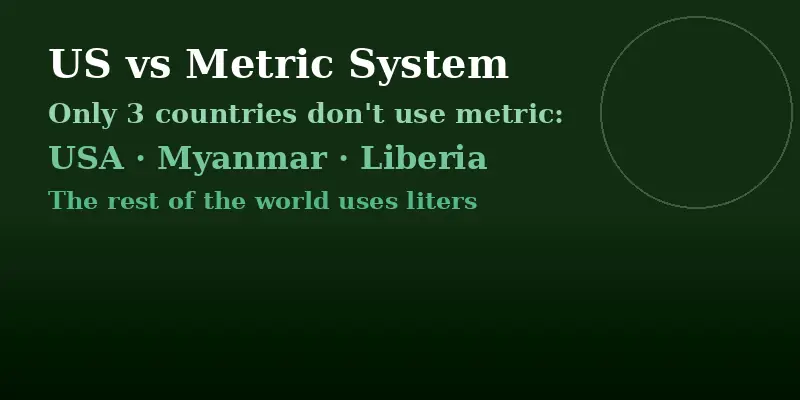
Three countries have not officially adopted the metric system as their primary measurement standard: the United States, Myanmar, and Liberia. Of these, the US is by far the most economically significant, which is why its measurement choices have global consequences.
Several other countries use gallons informally or in specific contexts:
- United Kingdom: Officially metric, but still references imperial gallons in fuel economy (mpg) and road distances (miles). British pubs serve beer in imperial pints.
- Canada: Officially metric, but older generations and some informal contexts still reference imperial gallons. Fuel is sold in liters.
- Antigua, Belize, and some Caribbean nations: Use US gallons for fuel sales due to close economic ties with the United States.
For a deeper look at how UK and US gallons differ — they are not the same size — see our dedicated guide: UK Gallon vs US Gallon.
Gallon vs Liter: A Clear Comparison
Numbers make the gallon vs liter difference concrete. Here's how they stack up:
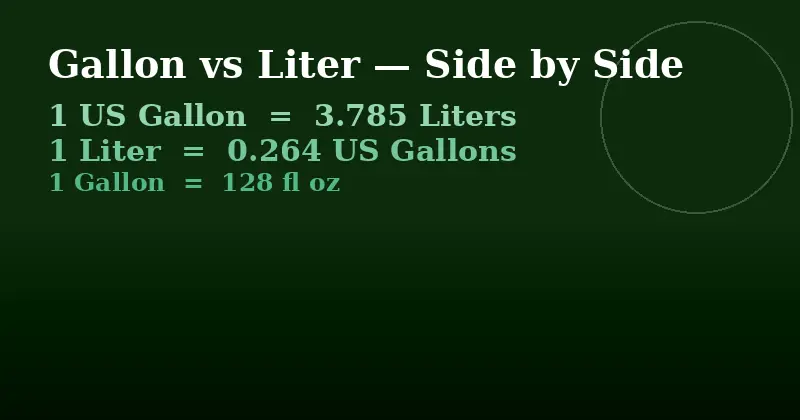
| Measurement | US Gallon | Liter |
|---|---|---|
| 1 unit equals | 3.785 liters | 0.2642 US gallons |
| In fluid ounces | 128 US fl oz | 33.814 US fl oz |
| In milliliters | 3,785 mL | 1,000 mL |
| In quarts | 4 quarts | 1.057 quarts |
| System | US customary | Metric (SI) |
| Used in | USA, Liberia, Myanmar | Most of the world |
| Mathematical base | Factors of 2 and 4 | Base-10 decimal |
The metric advantage is obvious on paper: dividing and multiplying by 10 is far simpler than navigating gallons → quarts → pints → cups → fluid ounces. But simplicity on paper doesn't always win in the real world — as America's measurement history clearly shows.
For instant gallon-to-liter and liter-to-gallon calculations, use our free oz to liter converter.
Real-Life Importance: Fuel, Cooking, and Daily Use
Understanding why the US uses gallons matters beyond historical curiosity — it has very practical implications every day.
Fuel and Gas Prices
Every American gas station prices fuel per gallon. When fuel costs spike, news headlines report "gas at $4 per gallon." Travellers from metric countries are often surprised that US fuel appears cheaper per unit — until they realise a gallon is nearly four times the size of a liter.
A European car rated at 6 liters per 100 km and an American car rated at 40 miles per gallon are using entirely different measurement frameworks to express the same concept. Converting between the two requires both a distance conversion and a volume conversion simultaneously.
Cooking and Recipes
American recipes use cups, fluid ounces, quarts, and gallons. When following a British or European recipe, the same measurements appear in milliliters, deciliters, and liters. A recipe calling for "1 liter of chicken stock" means about 4.23 US cups or 33.8 fluid ounces — not an intuitive conversion for most American cooks.
This is exactly why conversion tools matter. Knowing how to move between fluid ounces to gallons and back again isn't just academic — it's a practical cooking skill. See our complete liquid measurement conversion chart for a full reference covering all units in one place.
Purchasing and Comparing Products
American beverage labels show fluid ounces. Most imported products show milliliters. When a US water bottle says "16.9 fl oz" and a European one says "500 mL," they are the same size — but you wouldn't know that without the conversion. This dual-labelling gap makes our oz to liter converter a genuinely useful daily tool for anyone shopping across both systems.
International Trade and Industry
The measurement gap between the US and the rest of the world creates real friction in international commerce. American manufacturers that export products must often produce separate packaging with metric labelling. Engineers working on international projects must constantly convert between systems. The 1999 Mars Climate Orbiter mission was famously lost — a $327 million spacecraft — partly because one engineering team used imperial units while another used metric, and nobody caught the mismatch.
This is why most American scientific, medical, and engineering work already uses metric internally, even if consumer products still show gallons and ounces on their labels.
Daily Hydration Tracking
Many fitness and health apps use both liters and ounces simultaneously. A daily water goal of "2 liters" is the same as about 67.6 fluid ounces or just over half a gallon (0.528 gal). Understanding why the US uses gallons instead of liters helps you navigate health content from different countries without confusion.
Conclusion — Will the US Ever Switch to Liters?
Probably not completely — at least not any time soon. The infrastructure cost is enormous, public appetite for change is low, and the US economy is large enough to largely set its own terms. American consumers buy American products measured in American units, and that self-reinforcing loop is hard to break.
That said, the US is more metric than most Americans realise. Medicine, science, the military, and most international-facing industries already work in metric. Two-liter soda bottles are everywhere. Nutrition labels show both systems. The transition is happening gradually, industry by industry, without a formal mandate.
For now, the gallon remains king at the gas pump, the grocery store, and the kitchen. And that means knowing how to convert between gallons, fluid ounces, and liters is genuinely useful — whether you're filling a tank, scaling a recipe, or just trying to make sense of a foreign product label.
For more context on the official US measurement standards, the National Institute of Standards and Technology (NIST) Metric Program documents America's ongoing — if slow — relationship with the metric system.