📋 Table of Contents
US Liquid Unit Hierarchy
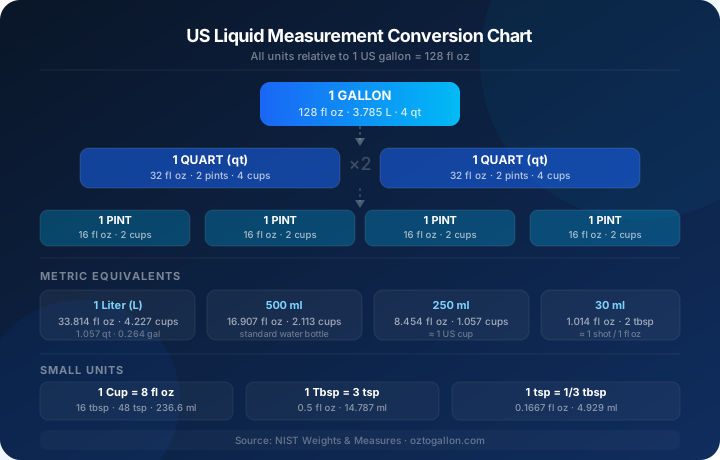
All US customary liquid units are defined relative to the gallon. The hierarchy flows in clean multiples — each unit is exactly double or quadruple the one below it, which makes mental conversion straightforward once you know the anchor points.
| Unit | fl oz | Cups | Pints | Quarts | Gallons |
|---|---|---|---|---|---|
| 1 Teaspoon | 0.167 | 0.021 | 0.010 | 0.005 | 0.0013 |
| 1 Tablespoon | 0.5 | 0.0625 | 0.031 | 0.016 | 0.0039 |
| 1 Fluid Ounce | 1 | 0.125 | 0.0625 | 0.031 | 0.0078 |
| 1 Cup | 8 | 1 | 0.5 | 0.25 | 0.0625 |
| 1 Pint | 16 | 2 | 1 | 0.5 | 0.125 |
| 1 Quart | 32 | 4 | 2 | 1 | 0.25 |
| 1 Gallon | 128 | 16 | 8 | 4 | 1 |
Complete Liquid Measurement Conversion Chart
This chart covers the most searched conversion values — organized from smallest to largest volume for easy scanning. Use it as a kitchen reference or bookmark it on your phone.
Cups to Fluid Ounces
| Cups | Fluid Ounces | Milliliters |
|---|---|---|
| ¼ cup | 2 fl oz | 59.1 ml |
| ⅓ cup | 2.67 fl oz | 78.9 ml |
| ½ cup | 4 fl oz | 118.3 ml |
| ⅔ cup | 5.33 fl oz | 157.7 ml |
| ¾ cup | 6 fl oz | 177.4 ml |
| 1 cup | 8 fl oz | 236.6 ml |
| 2 cups | 16 fl oz | 473.2 ml |
| 4 cups | 32 fl oz | 946.4 ml |
| 8 cups | 64 fl oz | 1,892.7 ml |
| 16 cups | 128 fl oz | 3,785.4 ml |
Pints, Quarts, and Gallons
| Pints | Quarts | Gallons | Fluid Ounces | Cups |
|---|---|---|---|---|
| 1 pt | 0.5 qt | 0.125 gal | 16 fl oz | 2 cups |
| 2 pt | 1 qt | 0.25 gal | 32 fl oz | 4 cups |
| 4 pt | 2 qt | 0.5 gal | 64 fl oz | 8 cups |
| 6 pt | 3 qt | 0.75 gal | 96 fl oz | 12 cups |
| 8 pt | 4 qt | 1 gal | 128 fl oz | 16 cups |
Tablespoons, Teaspoons & Fluid Ounces
Small-unit conversions matter most in baking, where a tablespoon off can change a recipe's texture entirely. These relationships are exact US definitions:
| Unit | Teaspoons | Tablespoons | Fluid Ounces | ml |
|---|---|---|---|---|
| 1 Teaspoon | 1 | ⅓ | 0.167 | 4.929 |
| 1 Tablespoon | 3 | 1 | 0.5 | 14.787 |
| 2 Tablespoons | 6 | 2 | 1 | 29.574 |
| ¼ Cup | 12 | 4 | 2 | 59.147 |
| ½ Cup | 24 | 8 | 4 | 118.294 |
| 1 Cup | 48 | 16 | 8 | 236.588 |
Baking shortcut: 3 teaspoons = 1 tablespoon = ½ fl oz. If a recipe calls for ½ fl oz of vanilla extract and you only have a teaspoon measure, use 3 level teaspoons.
Metric Conversions — Milliliters and Liters
Most packaged beverages and international recipes use metric units. These conversions bridge ml/L to US measures without needing a calculator for common values.
| Milliliters (ml) | Fluid Ounces | Cups | Closest US equivalent |
|---|---|---|---|
| 15 ml | 0.507 fl oz | 0.063 | 1 tablespoon |
| 30 ml | 1.014 fl oz | 0.127 | 1 fl oz / shot |
| 60 ml | 2.029 fl oz | 0.253 | ¼ cup |
| 120 ml | 4.058 fl oz | 0.507 | ½ cup |
| 240 ml | 8.115 fl oz | 1.014 | 1 cup (≈) |
| 250 ml | 8.454 fl oz | 1.057 | metric cup |
| 500 ml | 16.907 fl oz | 2.113 | standard water bottle |
| 750 ml | 25.361 fl oz | 3.170 | wine bottle |
| 1,000 ml (1 L) | 33.814 fl oz | 4.227 | 1-liter bottle |
| 2,000 ml (2 L) | 67.628 fl oz | 8.454 | soda bottle |
| 3,785 ml | 128 fl oz | 16 | 1 US gallon |
For precise liter-to-ounce calculations, use our liter to oz converter. For the reverse, the oz to liter converter handles any value instantly.
US vs Imperial: What Actually Differs
US and UK measurements share unit names — cups, pints, quarts, gallons — but the volumes are not the same. This causes the most common measurement mistake when following recipes from different countries.
| Unit | US Customary | UK Imperial | Difference |
|---|---|---|---|
| 1 Fluid Ounce | 29.574 ml | 28.413 ml | US is ~4% larger |
| 1 Cup | 236.588 ml | No standard cup | UK uses 250 ml metric cup |
| 1 Pint | 473.176 ml | 568.261 ml | UK is ~20% larger |
| 1 Quart | 946.353 ml | 1,136.5 ml | UK is ~20% larger |
| 1 Gallon | 3,785.4 ml | 4,546.1 ml | UK is ~20% larger |
Practical rule: US pints and gallons are about 17% smaller than their UK counterparts. If a British recipe calls for 1 pint of stock, you need roughly 1.2 US pints — or just weigh/measure by ml to avoid any ambiguity entirely.
Kitchen Memory Shortcuts
These are the relationships experienced cooks memorize rather than look up. Once you know them, most conversions become instant mental arithmetic:
- 2 cups = 1 pint — think of a pint glass as two coffee mugs
- 2 pints = 1 quart — a quart carton of milk holds four cups
- 4 quarts = 1 gallon — four quart containers fill one gallon jug
- 3 teaspoons = 1 tablespoon — the most mis-remembered small-unit fact
- 16 tablespoons = 1 cup — critical for scaling down baking recipes
- 1 fl oz ≈ 30 ml — close enough for most cooking; exact value is 29.574 ml
- 1 liter ≈ 1 quart + 3½ tablespoons — a liter is slightly larger than a quart
- 4 cups = 1 quart = 32 fl oz — the kitchen trinity worth memorizing
For larger volume work — fuel, water intake, bulk cooking — our oz to gallon calculator and quart to oz converter handle the math automatically. For hydration tracking by ounce, see our daily water intake guide.
All unit definitions on this page follow the NIST Weights & Measures standards — the official US authority on measurement definitions.
Frequently Asked Questions
Need a Specific Conversion?
Use our free calculators for any fl oz, gallon, liter, or quart conversion — instant, no sign-up.