UK Gallon vs US Gallon — Quick Comparison
When a recipe, fuel economy figure, or product label shows gallons, you need to know which gallon it means. The UK imperial gallon and the US liquid gallon share the same name but represent significantly different volumes — a difference large enough to cause real errors in cooking, fuel purchasing, and unit conversion.
| Property | US Liquid Gallon | UK Imperial Gallon |
|---|---|---|
| Fluid ounces | 128 US fl oz | 160 imperial fl oz |
| Litres | 3.785 L | 4.546 L |
| Millilitres | 3,785 mL | 4,546 mL |
| Quarts | 4 US quarts | 4 imperial quarts |
| Pints | 8 US pints | 8 imperial pints |
| Cups | 16 US cups | — |
| Size difference | — | ~20% larger than US |
| Primary use | USA | UK (informal) |
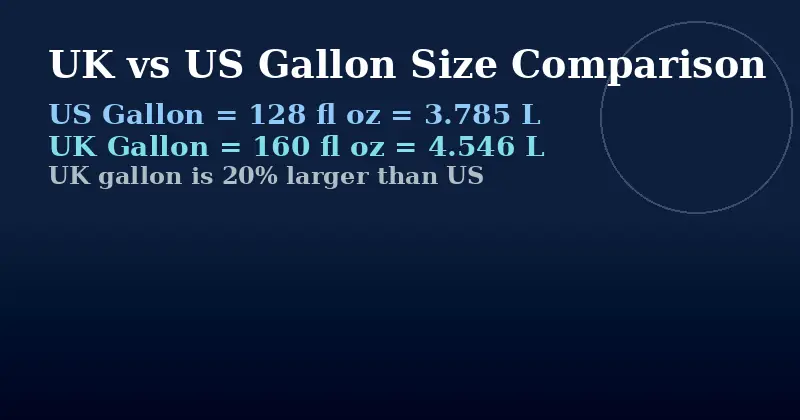
US Gallon vs Imperial Gallon Explained
Both gallons evolved from the same historical root — old English volume units — but they diverged permanently in 1824 when Britain standardised its imperial system. The US had already locked in its own gallon definition earlier, based on the old Queen Anne wine gallon of 231 cubic inches.
The result is two systems with the same name, incompatible volumes, and their own fluid ounce sizes. The US fl oz and UK imperial fl oz are also different — a detail that compounds the confusion when converting between the two systems.
For converting US fluid ounces to gallons, our oz to gallon converter uses the US liquid gallon throughout. For the reverse, use the gallon to oz tool.
How Many Ounces Are in a UK Gallon and US Gallon
This is where the comparison gets more layered — because the fluid ounce itself is also different between the two systems:
- US gallon: 128 US fluid ounces, where 1 US fl oz = 29.5735 mL
- UK imperial gallon: 160 imperial fluid ounces, where 1 UK fl oz = 28.4131 mL
Converting the UK gallon to US fluid ounces (not imperial fl oz):
So even though a UK gallon contains 160 imperial fl oz, it contains only about 153.72 US fl oz — because the US fl oz is slightly larger than the UK fl oz. This double-difference (different gallon sizes AND different fl oz sizes) is the root of most UK–US liquid conversion errors.
Why UK and US Gallons Are Different
The divergence happened in two distinct historical steps:
Step 1 — The American Revolution (1776)
When the United States became independent, it retained the measurement system already in common use — the British colonial system of that era, which included the old wine gallon of 231 cubic inches. This became the US liquid gallon, codified into US law in the early 19th century.
Step 2 — Britain's Imperial Reform (1824)
In 1824, Britain passed the Weights and Measures Act, which replaced the patchwork of old English gallons (wine, ale, corn) with a single standardised imperial gallon. This new gallon was defined as the volume of exactly 10 pounds of water at 62°F — which worked out to approximately 277.42 cubic inches, significantly larger than the American wine gallon.
The US was already independent and didn't adopt the 1824 reform. The two countries have used incompatible gallons ever since.
UK Gallon vs US Gallon Conversion Chart
This chart shows the most commonly needed UK-to-US gallon conversions, including litres and US fluid ounces for reference:
| UK Gallons | US Gallons | Litres | US Fluid Oz | Imperial Fluid Oz |
|---|---|---|---|---|
| 0.25 UK gal | 0.300 US gal | 1.136 L | 38.43 fl oz | 40 imp fl oz |
| 0.5 UK gal | 0.601 US gal | 2.273 L | 76.86 fl oz | 80 imp fl oz |
| 1 UK gal | 1.201 US gal | 4.546 L | 153.72 fl oz | 160 imp fl oz |
| 2 UK gal | 2.402 US gal | 9.092 L | 307.44 fl oz | 320 imp fl oz |
| 5 UK gal | 6.005 US gal | 22.73 L | 768.6 fl oz | 800 imp fl oz |
| 10 UK gal | 12.01 US gal | 45.46 L | 1,537 fl oz | 1,600 imp fl oz |
Imperial Gallon Ounces vs US Fluid Ounces
The fluid ounce difference between the two systems is smaller than the gallon difference, but it still matters in precise conversions:
| Unit | US Fluid Ounce | UK Imperial Fluid Ounce | Difference |
|---|---|---|---|
| 1 fl oz in mL | 29.5735 mL | 28.4131 mL | US is ~4% larger |
| fl oz per litre | 33.814 US fl oz/L | 35.195 imp fl oz/L | — |
| fl oz per gallon | 128 US fl oz | 160 imp fl oz | 32 fl oz more (imp) |
| 1 cup equivalent | 8 US fl oz = 236.6 mL | No standard "cup" | — |
US vs UK Liquid Measurements in Real Life
Fuel Economy
This is where the UK–US gallon difference causes the most confusion internationally. A British car achieving "50 miles per gallon (mpg)" is using the imperial gallon. Converting that to US mpg: 50 ÷ 1.20095 = 41.6 US mpg. The car sounds more fuel-efficient in UK terms than in US terms — same car, same efficiency, different number because of different gallon sizes.
Recipes
Older British recipes and some Commonwealth cookbooks specify liquid quantities in imperial gallons or imperial pints. An imperial pint = 20 imperial fl oz = 568 mL, while a US pint = 16 US fl oz = 473 mL. A recipe calling for "1 pint of milk" means very different quantities depending on which system is being used.
Beverages and Milk
In the UK, milk was historically sold in imperial pints and gallons. A "4-pint" bottle of UK milk contains 4 imperial pints = 2.273 litres. The same bottle labelled in US measurements would be approximately 4.8 US pints. Today most UK milk is sold in metric sizes, but the "pint" remains culturally embedded in British pub culture (a pint of beer = 568 mL in the UK vs 473 mL in the US).
Water and Hydration
Daily hydration goals referenced in British health content that say "drink 2 gallons" would mean 9.09 litres in imperial — an extremely large and unrealistic target. They almost certainly mean 2 litres (the metric standard), or the content was written using US conventions where 2 gallons = 7.57 litres — still high but more plausible. Context matters when reading international health content.
Which Countries Use UK and US Gallons
The global picture for gallon usage is actually simpler than most people expect:
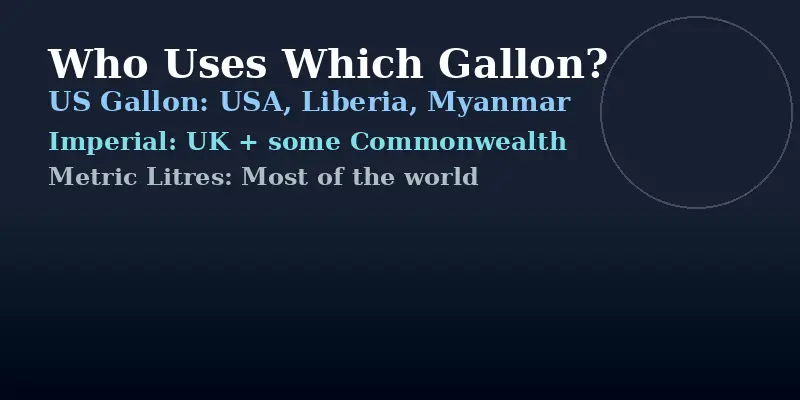
- US gallon: Used officially in the United States, Liberia, and Myanmar for everyday liquid measurements
- UK imperial gallon: No longer the official standard anywhere — the UK, Canada, Australia, and other former British territories all officially use metric (litres)
- Informal imperial use: The imperial gallon persists informally in the UK in fuel economy figures (mpg), some pub measurements (pints of beer), and older generations
- Canada: Officially metric, though fuel economy is sometimes quoted in mpg using the imperial gallon in older sources
- Rest of the world: Litres exclusively
In practical terms: if you see "gallons" on a US product or US website, it's the US gallon (128 fl oz). If you see "gallons" in a historical UK context or older British document, it's the imperial gallon (160 fl oz).
Common Conversion Mistakes to Avoid
Mistake 1 — Using US MPG Tables for UK Cars
US fuel economy comparison charts list mpg in US gallons. A UK car rated at 50 imperial mpg only achieves about 41.6 US mpg. If you use a UK car's mpg figure in a US fuel cost calculator, your estimate will be 20% too optimistic. Always confirm which gallon the mpg figure uses before calculating fuel costs.
Mistake 2 — Following Old British Recipes with US Measures
Pre-metric British recipe books use imperial pints and gallons. If you substitute US measuring tools, your liquid quantities will be about 20% short. A recipe calling for "1 gallon of stock" needs 4.546 litres in the UK original — not the 3.785 litres a US gallon jug provides.
Mistake 3 — Assuming All "fl oz" Are the Same
A UK product showing "10 fl oz" uses imperial fl oz (28.41 mL each = 284 mL total). A US product showing "10 fl oz" uses US fl oz (29.57 mL each = 296 mL total). For casual cooking this 4% difference is negligible, but in baking or laboratory contexts it matters. See our full explainer: Difference Between Oz and Fl Oz.
Mistake 4 — Thinking Canada Uses US Gallons
Canada is metric. Gas stations sell litres, not gallons. When Canadian media quotes fuel economy in "mpg," it is typically using the imperial gallon — not the US gallon — due to historical British influence, even though Canada officially abandoned the imperial system decades ago.
For all US-based gallon and ounce conversions, use our free tools: gallon to oz converter and oz to gallon converter.
The official definition of the US gallon is maintained by the National Institute of Standards and Technology (NIST).