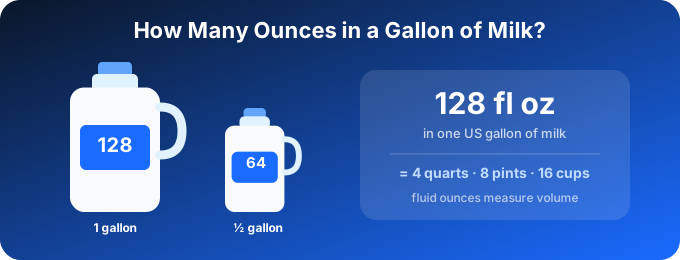
Standing in the dairy aisle with a recipe in one hand, it is fair to wonder how many ounces in a gallon of milk. The answer is 128 fluid ounces. That holds for whole, 2%, skim, lactose-free and plant-based milks alike, because a fluid ounce measures how much space a liquid takes up, not what the liquid is.
The rest of this guide covers half gallons and smaller cartons, the difference between fluid ounces and the ounces on a kitchen scale, and the UK and Canadian sizes that do not match a US gallon.
📋 Table of Contents
How many ounces in a gallon of milk, exactly?
One US liquid gallon is 128 US fluid ounces, so a gallon of milk contains 128 fl oz. The gallon itself is a fixed volume: NIST Handbook 44 (see Appendix C) lists it as 231 cubic inches, divided into 4 quarts. Splitting each quart into 32 fluid ounces gives the 128 you see on the jug.
| One gallon of milk equals | Amount |
|---|---|
| Fluid ounces | 128 fl oz |
| Cups | 16 cups |
| Pints | 8 pints |
| Quarts | 4 quarts |
| Milliliters | ≈ 3,785 mL |
Half gallons, quarts and smaller cartons
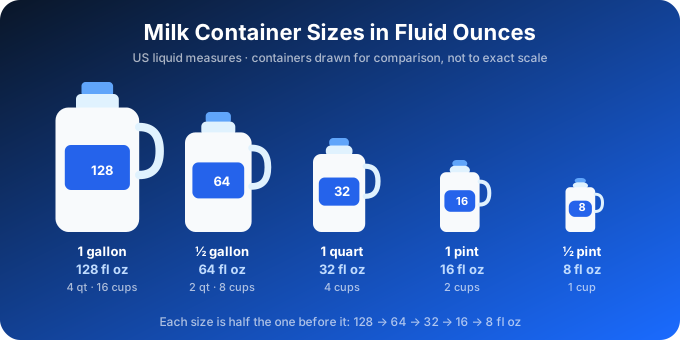
Every common milk size is a simple fraction of a gallon, so the ounces follow the same pattern. So how many ounces are in a half gallon of milk? 64 fluid ounces, exactly half of 128. A quart holds 32, a pint holds 16, and the little half-pint cartons that turn up in school lunches hold 8.
| Milk container | Fluid ounces | Cups | Fraction |
|---|---|---|---|
| 1 gallon | 128 fl oz | 16 | 1 gal |
| ½ gallon | 64 fl oz | 8 | ½ gal |
| 1 quart | 32 fl oz | 4 | ¼ gal |
| 1 pint | 16 fl oz | 2 | ⅛ gal |
| ½ pint | 8 fl oz | 1 | 1/16 gal |
Fluid ounces vs ounces on a scale
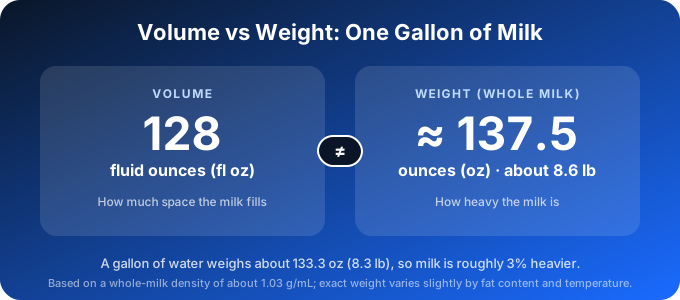
Here is where people get tripped up. The 128 on the jug is fluid ounces, a measure of volume. Put that same gallon on a kitchen scale and the display will show a bigger number, because milk is slightly denser than water. Using a typical whole-milk density of about 1.03 g/mL, a gallon weighs roughly 137.5 oz, or 8.6 pounds. A gallon of water comes in at about 133.3 oz (8.3 lb).
| Container | Volume | Approx. weight (oz) | Approx. weight (lb) |
|---|---|---|---|
| 1 gallon | 128 fl oz | ≈ 137.5 oz | ≈ 8.6 lb |
| ½ gallon | 64 fl oz | ≈ 68.8 oz | ≈ 4.3 lb |
| 1 quart | 32 fl oz | ≈ 34.4 oz | ≈ 2.1 lb |
| 1 pint | 16 fl oz | ≈ 17.2 oz | ≈ 1.1 lb |
| 1 cup | 8 fl oz | ≈ 8.6 oz | ≈ 0.5 lb |
Whole, 2% and skim milk differ from each other by only a fraction of a percent, so treat these as working figures; real weights shift a little with fat content and temperature, and the jug adds its own weight. When a recipe or label lists milk in ounces, it almost always means fluid ounces. Our fluid ounce vs ounce guide explains how to tell them apart for any ingredient.
UK and Canadian gallons of milk
The 128 figure belongs to the US gallon. The UK uses the imperial gallon, which is 160 imperial fluid ounces, or about 4.546 litres. An imperial fluid ounce is a touch smaller than a US one (28.41 mL against 29.57 mL), so an imperial gallon works out to roughly 153.7 US fluid ounces. In practice, UK shops sell milk by the pint and the litre rather than the gallon, and Canadian shops sell it in litres.
| Size | Stated amount | In US fluid ounces | Milliliters |
|---|---|---|---|
| US gallon | 128 US fl oz | 128 | ≈ 3,785 mL |
| UK imperial gallon | 160 imperial fl oz | ≈ 153.7 | ≈ 4,546 mL |
| Canadian 4 L jug | 4 litres | ≈ 135.3 | 4,000 mL |
The same split between US and UK sizes affects pints too, which our US pint vs UK pint comparison walks through.
Putting the number to work
Once you know a gallon is 128 fl oz, any milk quantity is one step of arithmetic:
📐 Formula
Fluid ounces = Gallons × 128
Gallons = Fluid ounces ÷ 128
For example, a recipe that needs 96 fl oz of milk calls for 96 ÷ 128 = 0.75 gallon, which is 3 quarts. For quick answers on any amount, use our gallon to oz converter, or try the gallons to quarts converter if you prefer thinking in quarts.
The same number helps with serving sizes. A gallon fills sixteen 8-ounce glasses or about ten and two-thirds 12-ounce mugs. Many US nutrition labels list a serving of milk as 1 cup (240 mL), which makes a gallon about 15.8 labeled servings rather than a neat 16.